India and New Zealand have taken a significant step toward strengthening bilateral economic ties with the finalisation of the India-New Zealand Free Trade Agreement (FTA). The announcement followed a telephonic conversation between Prime Minister Narendra Modi and New Zealand Prime Minister Christopher Luxon, marking a major milestone in trade, investment, and strategic cooperation between the two nations.
Negotiations for the agreement began during Prime Minister Luxon’s visit to India in March 2025, with both countries positioning the pact as a forward-looking framework to enhance economic engagement and unlock long-term growth opportunities.
Overview of the India-New Zealand FTA
The India–New Zealand FTA is designed to:
- Enhance trade, investment, innovation, and mobility
- Improve market access for goods and services
- Encourage investment flows and job creation
- Support MSMEs, farmers, entrepreneurs, students, and youth
- Strengthen strategic and economic cooperation
The agreement aims to double bilateral trade within the next five years, creating wide-ranging opportunities across multiple sectors.
Zero-Duty Access for Indian Exports
One of the most significant outcomes of the FTA is zero-duty access for Indian exports to New Zealand, with tariff elimination across all tariff lines.
Key Beneficiaries:
- Farmers and agricultural producers
- MSMEs and labour-intensive industries
- Artisans, women-led enterprises, and youth
- Export-oriented manufacturing sectors
Major Gaining Sectors:
- Textiles and apparel
- Leather and footwear
- Engineering goods
- Automobiles and auto components
- Electronics and machinery
- Plastics
- Pharmaceuticals and chemicals
Boost to Manufacturing and Industrial Growth
The FTA supports India’s manufacturing ecosystem by improving access to New Zealand’s market while promoting deeper industrial collaboration. Reduced tariffs and simplified trade procedures are expected to enhance India’s global competitiveness in value-added and technology-driven sectors.
Strong Focus on Agriculture & Farmers
Agriculture is a key pillar of the agreement. Indian farmers will gain improved access to New Zealand’s market for products such as:
- Fruits and vegetables
- Coffee and spices
- Cereals
- Processed food products
Agricultural Cooperation Initiatives:
- Agricultural Productivity Partnership
- Centres of Excellence
- Access to New Zealand’s advanced agricultural technologies
These initiatives aim to improve productivity, quality, sustainability, and farm incomes.
Targeted measures have also been introduced for horticultural products such as honey, kiwifruit, and apples, supporting long-term sectoral growth.
Protection for Sensitive Indian Sectors
To safeguard domestic interests, India has excluded sensitive sectors from tariff concessions, ensuring protection for farmers, MSMEs, and local industries.
Protected Sectors Include:
- Dairy products
- Sugar
- Coffee and spices
- Edible oils
- Gold, silver, and precious metals
- Precious-metal scrap
- Copper cathodes
- Rubber-based products
Services, Mobility & Education Opportunities
The FTA significantly expands cooperation in services:
- New Zealand:
- Market access in 118 service sectors
- MFN treatment in 139 service sectors
- India:
- Market access in 106 service sectors
- MFN treatment in 45 service sectors
Key service areas include:
- Information Technology & IT-enabled services
- Finance
- Education
- Tourism
- Construction
A notable feature is the Annex on Health and Traditional Medicine Services, signed by New Zealand for the first time with any country.
Student Mobility & Work Visas
For the first time, New Zealand has signed an Annex on Student Mobility and Post-Study Work Visas with another nation.
Key Provisions:
- No numerical caps on Indian students
- Right to work 20 hours per week
- Post-study work visas:
- Up to 3 years for STEM bachelor’s graduates
- Up to 3 years for master’s graduates
- Up to 4 years for doctoral graduates
New Pathways for Indian Professionals
The agreement introduces a Temporary Employment Entry Visa pathway:
- Up to 5,000 Indian professionals
- Stay of up to 3 years
Eligible Professions Include:
- AYUSH practitioners
- Yoga instructors
- Indian chefs
- Music teachers
- IT professionals
- Engineers
- Healthcare, education, and construction professionals
Additionally, a Working Holiday Visa arrangement allows 1,000 young Indians annually to travel to New Zealand with multiple entries for a 12-month period.
Investment Commitments & Economic Impact
New Zealand has committed to investing USD 20 billion in India over 15 years, following a framework similar to the European Free Trade Association (EFTA) model.
Investment Focus Areas:
- Manufacturing
- Infrastructure
- Services
- Innovation
- Employment generation
This investment is expected to significantly strengthen India’s long-term economic and industrial landscape.
Tariff Reductions on Goods
Under the agreement:
- India’s average MFN tariff will fall from 16.2% to 13.18% upon implementation
- Reduced further to 10.30% after 5 years
- Declines to 9.06% by the 10th year
Market access has been granted on 70.03% of tariff lines, while 29.97%—mainly sensitive sectors—remain excluded.
Trade Outlook & Current Figures
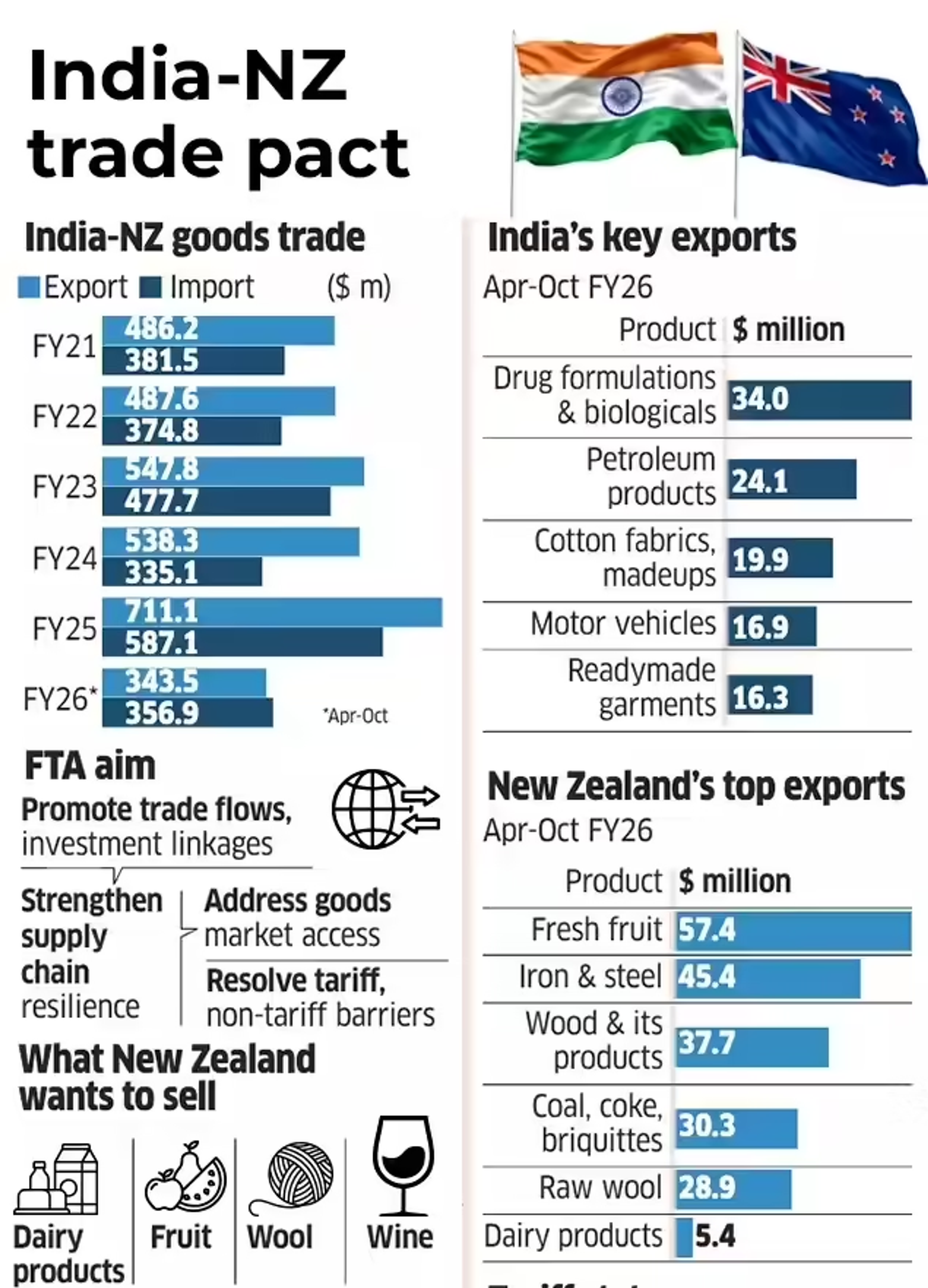
- Bilateral merchandise trade (FY 2024–25): USD 1.3 billion
- Total trade in goods & services (2024): USD 2.4 billion
- Services trade alone: USD 1.24 billion
New Zealand Prime Minister Christopher Luxon highlighted that the FTA removes or reduces tariffs on 95% of New Zealand exports to India, with exports forecasted to grow by USD 1.1–1.3 billion annually over the next two decades.
Conclusion
The India-New Zealand Free Trade Agreement marks a transformative chapter in bilateral relations. By combining tariff liberalisation, investment commitments, services expansion, and enhanced mobility, the FTA is set to create long-term economic growth, employment opportunities, and innovation-led collaboration for both nations.
For exporters, manufacturers, service providers, students, and entrepreneurs, this agreement opens the door to new markets, stronger partnerships, and shared prosperity.